Duroplast vs thermoplastic toilet seat
Jul 25, 2022
Top Viewed Articles
For Duroplast and PP material, they both belong to plastic.
The difference: Duroplast it is Thermosetting plastics, PP it is Thermoplastic.
The raw materials, production processes of these two types of toilet seats are very different.
Duroplast toilet seat(also known as UF toilet seat) is a new type of plastic. It is made of raw materials and then pressed into powder at high temperature. The compression moulding process is used. The UF toilet seat has a ceramic texture, high gloss, stable color and scratch resistance. Strong, durable, not easy to age, fade, stable performance, resistant to some chemicals, can be naturally degraded in nature after being discarded, and will not cause pollution. The disadvantage is that it is not resistant to falling.

The toilet seat made of PP is made of pure PP raw rice through hot-melting molding, and the injection molding process is used. The disadvantage is that it is not scratch-resistant.

The two material toilet seats have their own advantages and disadvantages, and the price of urea toilet seats will be slightly more expensive.
Duroplast vs PP Toilet Seats: Which Should Importers Choose?
For importers, wholesalers and distributors, the better material depends on the target market, product positioning and required performance.
| Factor | Duroplast / UF | PP |
|---|---|---|
| Material type | Thermoset | Thermoplastic |
| Production process | Compression moulding | Injection moulding |
| Surface | Hard and rigid | More flexible |
| Appearance | Ceramic-like | Depends on design and finish |
| Scratch resistance | Generally higher | Generally lower |
| Cigarette-burn resistance | Better resistance to brief surface exposure | Generally lower |
| UV & colour stability | Good UV resistance and colour retention | Depends on formulation and pigments |
| Antistatic properties | Helps reduce dust adhesion | Depends on material formulation |
| Impact resistance | Lower flexibility | Generally higher |
| Weight | Generally heavier | Generally lighter |
| Shape stability | High | More flexible |
| Cost positioning | Generally higher | Generally lower |
These are general material characteristics. Actual performance depends on the material formulation, product structure, surface finish, mould design and manufacturing quality.
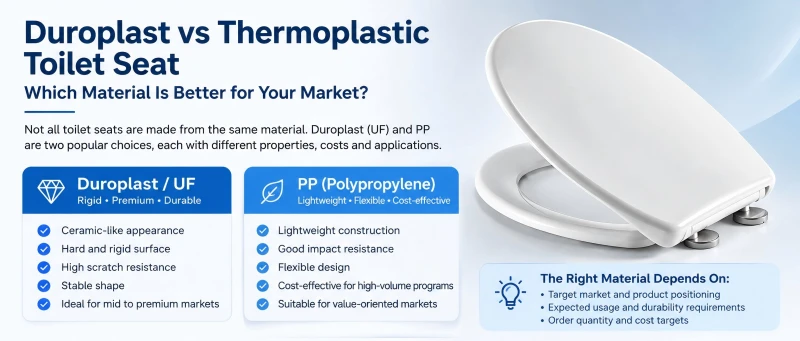
Which Toilet Seat Material Is Better for Your Market?
There is no universal "best" material.
Choose Duroplast when:
Surface appearance is important
A hard and rigid seat is preferred
Scratch resistance is an important consideration
Colour stability is important
Antistatic surface properties are desirable
The product is positioned in the mid-to-premium segment
Buyers expect a ceramic-like feel
Consider PP when:
Lightweight construction is preferred
Impact resistance is important
Price competitiveness is a major consideration
The program requires high-volume production
The target market is more cost-sensitive
For a B2B buyer, the decision should therefore be based on target market, product positioning, expected usage and purchasing cost rather than material name alone.
Is Duroplast More Expensive Than PP?
Duroplast toilet seats generally have a higher unit cost than basic PP models, but unit price is only one part of the purchasing decision.
For an importer, the overall cost can also be affected by:
Material + hinge + production process + product weight + packaging + shipping + quality requirements
For example, PP may be preferred for a cost-sensitive, high-volume program, while Duroplast may be selected when surface appearance, rigidity, colour stability and product positioning are more important.
The better question is:
Which material provides the required performance and market positioning at the target landed cost?
What Should Importers Check Before Choosing a Toilet Seat?
Before requesting quotations, buyers should define several basic requirements.
1. Target market
Identify the country or market where the toilet seat will be sold. Product expectations can vary between markets.
2. Product positioning
Decide whether the seat is intended for an entry-level, mainstream or premium product range.
3. Expected order quantity
Estimated volume can affect production planning, packaging requirements and overall purchasing cost.
4. Toilet shape and dimensions
Material selection should be considered together with the required seat shape, dimensions and fitting requirements.
5. Hinge configuration
The hinge can significantly affect the function and final cost of the toilet seat.
Depending on the project, buyers may compare standard, soft-close, quick-release or adjustable fixing systems.
6. Quality requirements
Before bulk production, buyers should define requirements for dimensions, surface finish, hinge performance, load performance and appearance.
What Should Importers Ask a Toilet Seat Manufacturer?
Before approving a supplier, buyers can ask:
What material is used for the toilet seat?
Is the Duroplast material UF-based?
What is the actual finished weight?
Which hinge options are available?
What ceramic fitting range does the seat support?
How is hinge performance tested?
What load or functional testing is performed?
What is the MOQ for the selected model?
What OEM changes can be supported?
Can a sample be approved before bulk production?
These questions allow buyers to compare suppliers based on the complete product specification rather than unit price alone.
How Should Buyers Compare Duroplast and PP Samples?
If you are unsure which material is suitable, comparing physical samples is more useful than relying only on catalogue descriptions.
Check:
Surface: appearance, gloss, colour consistency and visible finish
Hardness: overall rigidity and surface feel
Surface durability: visible scratches and marks after handling
Colour: consistency and appearance under different lighting
Hinge: alignment, fixing stability and closing performance
Installation: hinge spacing and compatibility with the intended ceramic
Weight: actual finished product weight
For an OEM project, the approved sample should become the reference for subsequent mass production.
Duroplast or PP: A Simple Buying Decision
A simple way to approach the decision is:
Need a hard, rigid surface, good colour stability and a more premium product position?
→ Consider Duroplast / UF.
Need lower weight, greater flexibility and cost efficiency?
→ Consider PP.
Need better surface properties such as antistatic performance or resistance to brief cigarette-burn exposure?
→ Duroplast may be the more suitable option, depending on the application.
Not sure which one fits your market?
→ Compare samples based on your target price, expected volume, product positioning and performance requirements.
There is no universal winner between Duroplast and PP. The right choice is the material that best matches the complete product specification.
Frequently Asked Questions
Is Duroplast the same as UF?
In the toilet seat industry, Duroplast toilet seats are commonly associated with UF (urea-formaldehyde) thermoset material. The terms are therefore often used together when describing this type of toilet seat.
Is PP a thermoplastic?
Yes. PP, or polypropylene, is a thermoplastic material commonly processed through injection moulding.
Which is more scratch resistant, Duroplast or PP?
Duroplast generally has a harder surface and better resistance to everyday scratching than standard PP toilet seats. Actual performance depends on the material formulation and surface finish.
Is Duroplast UV resistant?
Duroplast generally provides good UV resistance and colour retention. However, long-term colour stability also depends on pigments, formulation and the intensity and duration of UV exposure.
Is Duroplast antistatic?
Duroplast has antistatic characteristics that can help reduce dust adhesion to the surface. The actual effect depends on the material formulation and surface condition.
Which toilet seat is lighter, Duroplast or PP?
PP toilet seats are generally lighter than comparable Duroplast models, although actual weight depends on the product design and structure.
Is Duroplast always better than PP?
No. Duroplast and PP have different characteristics. Duroplast may be preferred for rigidity, surface hardness, colour stability and certain surface properties, while PP can be more suitable when lightweight construction, impact resistance and cost efficiency are priorities.
Need Help Choosing the Right Toilet Seat Material?
If you are comparing Duroplast and PP for a wholesale, distribution or OEM program, send us your:
Target market
Estimated order quantity
Preferred toilet seat shape
Target price range
OEM or private-label requirements
We can help you evaluate the suitable material, hinge configuration and product specification before you move to bulk production.
Request a Material & Product Recommendation