


What Separates A Professional Integrated Bidet Toilet Bowl Factory That Holds CE And DVGW From One That Doesn't?
Jul 28, 2026
What Separates a Professional Integrated Bidet Toilet Bowl Factory That Holds CE and DVGW From One That Doesn't?
The integrated bidet toilet category has expanded sharply across European bathrooms over the past decade, driven by rising consumer interest in hygiene-focused sanitary ware and aging-in-place renovation projects.
Yet this growth has also attracted scrutiny from regulators, building inspectors, and water utility authorities. Choosing a Professional Integrated Bidet Toilet Bowl Factory that holds both CE and DVGW certifications has therefore become a baseline expectation rather than a differentiator.
Behind these two acronyms lies a substantial gap in engineering discipline, hydraulic safety understanding, and supply chain traceability-a gap that often determines whether a product reaches store shelves or stalls at customs.

What Do CE and DVGW Certifications Actually Verify in an Integrated Bidet Toilet Bowl?
CE marking signals conformity with multiple EU directives. For smart toilet products, these typically include the Low Voltage Directive covering electrical safety, the EMC Directive addressing electromagnetic interference, and material regulations governing substances in contact with users.
Although CE is mandatory, its scope alone does not address every risk inherent in a product that connects directly to municipal water lines.
DVGW certification, issued by the German Technical and Scientific Association for Gas and Water, fills that gap. It evaluates hydraulic components against drinking water hygiene requirements, verifying that valves, hoses, and inlet assemblies will not release contaminants or permit cross-contamination.
Holding both certifications therefore indicates dual competency: one in electrical and electronic safety, another in waterborne hygiene engineering. Factories carrying only CE often lack the laboratory infrastructure and material discipline that DVGW demands.
How Do EN 1717 and EN 13077 Standards Protect Municipal Drinking Water from Backflow Contamination?
Backflow is a quiet but serious risk. When pressure in a municipal supply line drops unexpectedly-during firefighting events, pipe repairs, or peak demand-water can reverse direction and draw fluid from connected appliances back into the public network.
For a bidet, that reverse flow could carry biological contaminants into shared drinking water.
EN 1717 classifies fluids into five risk categories and prescribes specific backflow prevention devices for each. Bidet applications generally fall under Category 5, the highest risk tier, which requires unconditional separation.
EN 13077 then defines the technical geometry of air gap protection, specifying Type AA and Type AB configurations as the most secure mechanical barriers.
Factories operating under these standards integrate dedicated backflow prevention modules into the water inlet pathway, rather than relying on simple check valves.
This engineering choice protects entire buildings, not just the individual user.
Why Does Modular Component Architecture Define a Factory's Long-Term Service Capability?
Smart toilet bowls combine ceramic, electronic, and hydraulic subsystems in a compact envelope. When components are bonded into sealed units, even a single sensor failure can require complete unit replacement.
Modular architecture, by contrast, allows technicians to swap individual subassemblies-nozzles, solenoid valves, control boards, or heating elements-without dismantling the entire fixture.
This distinction carries significant commercial weight. Service response times shrink, spare parts inventories become manageable, and the product's effective lifecycle extends well beyond its warranty period.
Beewill applies modular design thinking across its smart sanitary line, structuring replaceable nozzle assemblies, accessible valve clusters, and removable control electronics.
Combined with documented maintenance guidance, this approach supports distributors who manage end-customer service obligations across multiple regions.
How Does Mechatronic Integration Discipline Affect Product Reliability in Smart Toilet Bowls?
Integrating water heating, nozzle actuation, seat occupancy sensing, and microcontroller logic within a moisture-rich ceramic shell presents genuine engineering challenges.
Poorly executed integration often shows up as leakage along seal interfaces, sensor drift caused by humidity exposure, or PCB corrosion from condensate intrusion. Such failures rarely appear during factory testing; instead, they emerge months after installation, damaging brand reputation.
A disciplined factory addresses these risks at the design stage. Conformal coating on circuit boards, sealed cable glands, thermally isolated heater modules, and validated waterproofing ratings all contribute to long-term reliability.
Xiamen Beewill Sanitary Co., Ltd. invests in R&D-led product development across its smart bathroom portfolio, refining the interface between electronic systems and hydraulic flow paths.
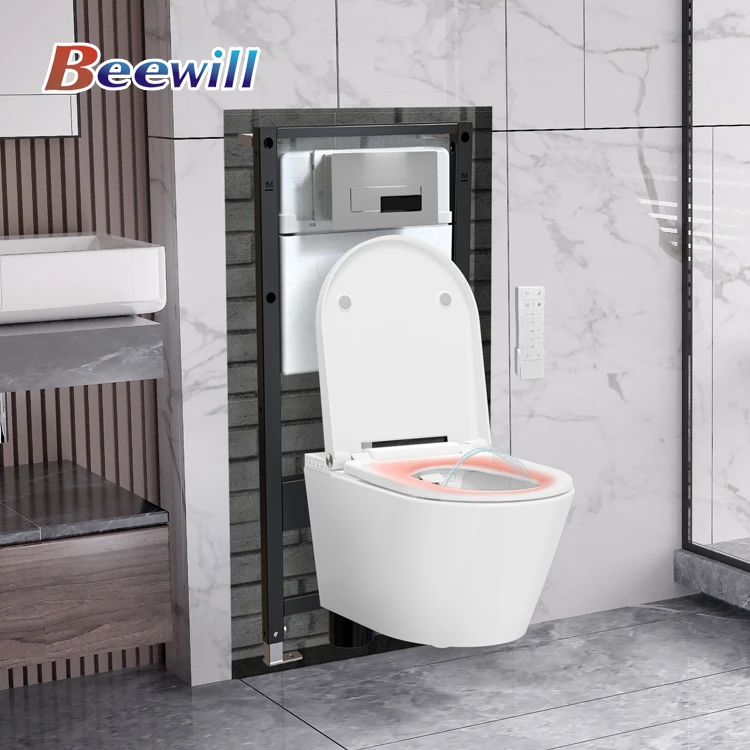
The company's toilet with integrated bidet range reflects this integration discipline, balancing user-facing functionality with internal engineering rigor that supports stable operation over years of daily use.
What Role Does Barcode-Based Traceability Play in Supply Chain Transparency and Recall Readiness?
European market surveillance authorities have steadily raised expectations around product traceability. When a defective batch surfaces, regulators expect manufacturers to identify affected units, trace component origins, and execute targeted recalls within tight timeframes.
Factories without component-level tracking systems struggle to meet these obligations, often resorting to broad recalls that damage commercial relationships.
Barcode-based traceability solves this problem at its root. Each incoming component, from ceramic body to control module, receives a scan record that follows the unit through assembly, testing, and dispatch.
If a field issue arises, engineers can isolate the root cause within hours rather than weeks.
Beewill (Xiamen Beewill Sanitary Co., Ltd.) operates a structured quality assurance system that includes incoming material inspection, in-process quality control, and outgoing quality control, supported by traceable batch records.
This infrastructure shortens investigation cycles and demonstrates a level of process maturity that EU buyers increasingly require during supplier audits.
How Should Buyers Interpret Certification Status When Comparing Factories?
A certification logo on a brochure means little without context. Procurement teams need to verify the issuing body, the certificate scope, the specific product models covered, and the current validity period.
Some factories hold certifications for a single representative model while claiming coverage across an entire catalog-a practice that can leave buyers exposed when customs authorities request matching documentation.
Reading certificates carefully reveals real capability. Coverage of multiple product families, recent renewal dates, and recognized issuing bodies all point toward sustained compliance investment rather than one-time effort.
Beewill (Xiamen Beewill Sanitary Co., Ltd.), founded in 2010 and headquartered in Xiamen, has built its export operations around full-system competency in sanitary ware manufacturing, supporting buyers with documentation packages that align with EU market entry requirements.
Such transparency helps procurement teams distinguish between factories that treat certification as a marketing claim and those that treat it as an operational standard.
Summary
Certifications such as CE and DVGW are not administrative paperwork; they represent evidence of disciplined engineering, hygiene awareness, and traceability practice.
The gap between factories that hold both certifications and those that do not continues to widen as European regulations tighten and buyer expectations mature.
Backflow prevention design, modular serviceability, mechatronic integration, and component-level traceability collectively define what professional manufacturing looks like in the integrated bidet toilet category.
Looking for a Professional Integrated Bidet Toilet Bowl Manufacturer?
Whether you're sourcing certified integrated bidet toilet bowls for distribution, retail, hospitality projects, or OEM/ODM cooperation, Beewill provides engineering-driven sanitary solutions backed by international certifications, rigorous quality control, and reliable manufacturing capabilities.
For more information about our integrated bidet toilet range, certifications, technical documentation, and customization services, please visit our official website: https://www.beewill.com/


