

Do Concealed Cisterns Need EN 14055 or CE Certification?
May 15, 2026
Do Concealed Cisterns Need EN 14055 or CE Certification?
Do Concealed Cisterns Need EN 14055 or CE Certification?
Importers, distributors and sanitaryware brands often ask this question when sourcing from overseas: Do concealed cisterns need CE marking or EN 14055 certification to sell in Europe?
The short answer is: CE marking is usually not required, but EN 14055 testing and drinking water approvals are essential for market access.
This guide explains what buyers really need to know and how certification can be configured depending on the target market.
Quick Answer
- Concealed cisterns normally do NOT require CE marking.
- They DO need EN 14055 performance testing.
- Drinking water safety approvals are often required by the market.
- Australia requires mandatory WaterMark certification.
- Certification can be configured step-by-step based on your sales regions.
Are Concealed Cisterns Required to Have CE Marking?
Most concealed cisterns fall outside the scope of CE directives because they are:
- Non-electrical products
- Not medical devices
- Not structural construction materials
This means CE marking is typically not mandatory.
However, this does NOT mean there are no compliance requirements. European markets still require proof of performance, safety, and water system compatibility.
What Is EN 14055 and Why Is It Important?
EN 14055 is the key European performance standard for flushing cisterns. It is often misunderstood as a certification, but in reality it is a testing standard.
Products are tested by laboratories and issued a test report, not a certificate.
Typical EN 14055 tests include:
- Flush volume accuracy
- Flush efficiency
- Leakage and sealing performance
- Mechanical durability
- Noise level testing
This test report is typically the first document importers need before entering the European market.
The Hidden Compliance Focus: Drinking Water Safety
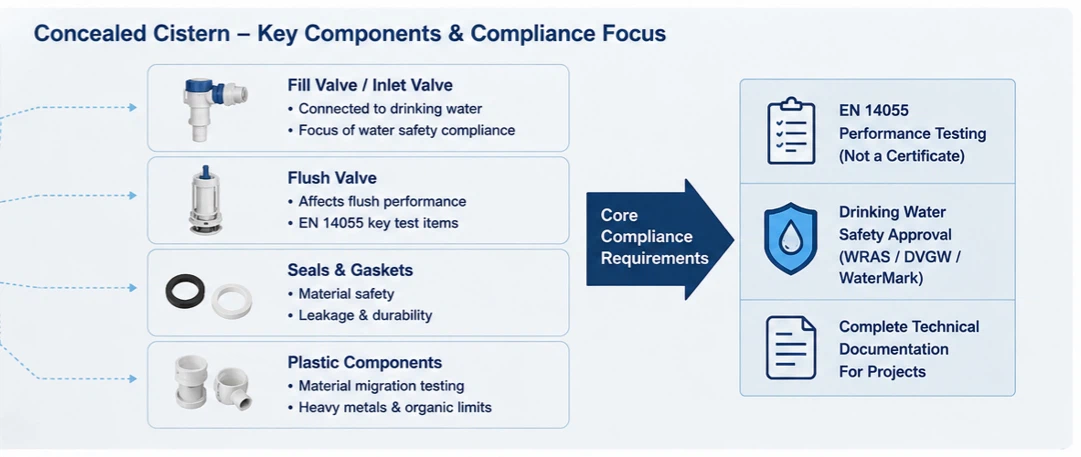
The biggest compliance challenge is often not the cistern tank itself, but the components connected to drinking water.
Critical parts include:
- Fill valve / inlet valve
- Rubber seals
- Plastic components in contact with water
These components must meet strict drinking water safety requirements such as:
- Material migration testing
- Heavy metal release limits
- Organic compound safety
- Microbial risk control
This is why many buyers hear about WRAS or DVGW approvals when entering European markets.
Certification Requirements by Target Market
| Market | Typical Requirement | Status |
|---|---|---|
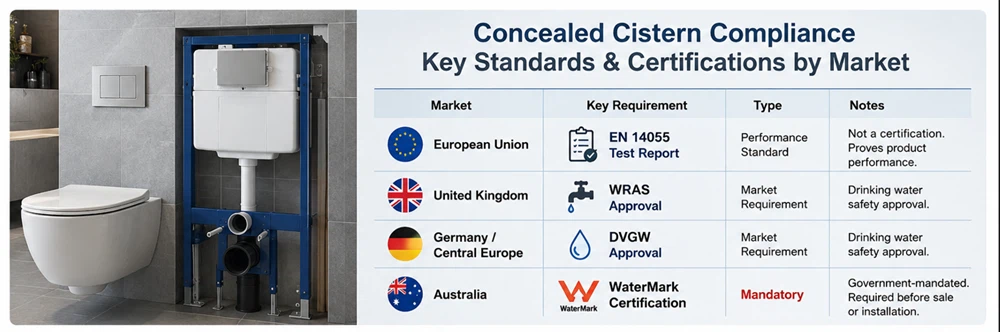
| European Union | EN 14055 Test Report | Performance standard |
| United Kingdom | WRAS Approval | Market requirement |
| Germany / Central Europe | DVGW Approval | Market requirement |
| Australia | WaterMark Certification | Mandatory |
Why WaterMark Certification Is Different
Australia operates one of the strictest plumbing approval systems in the world.
WaterMark certification is:
- Government-mandated
- Required before products can be sold or installed
- Applied to the complete cistern system
- Linked to factory quality audits
Without WaterMark approval, concealed cisterns cannot legally enter the Australian market.
What Large Importers and Projects Actually Require
For large distributors and project supply, compliance goes beyond single test reports. Buyers often require a complete technical documentation package.
This typically includes:
- EN 14055 test report
- Material compliance declarations
- Valve compliance documentation
- ISO 9001 quality system
- Installation manuals
- Exploded drawings and spare parts lists
This documentation demonstrates that a supplier can support long-term distribution and project supply.
Can Certification Be Configured for Different Markets?
Yes - and this is how most international brands expand globally.
Stage 1 - Enter the European Market
- EN 14055 testing
- Basic material compliance
Stage 2 - Expand to UK or Germany
- Add WRAS or DVGW approvals
Stage 3 - Enter Australia
- Apply for WaterMark certification
This step-by-step certification roadmap helps brands reduce upfront cost while expanding internationally.
Concealed cistern compliance is often misunderstood. CE marking is usually not required, but EN 14055 testing and drinking water approvals are essential for successful market entry.
For international buyers, the key is not just obtaining one certificate, but building the right certification strategy based on the target market.
With the correct testing, documentation, and certification roadmap, concealed cisterns can be successfully supplied to Europe, the UK, and Australia.


