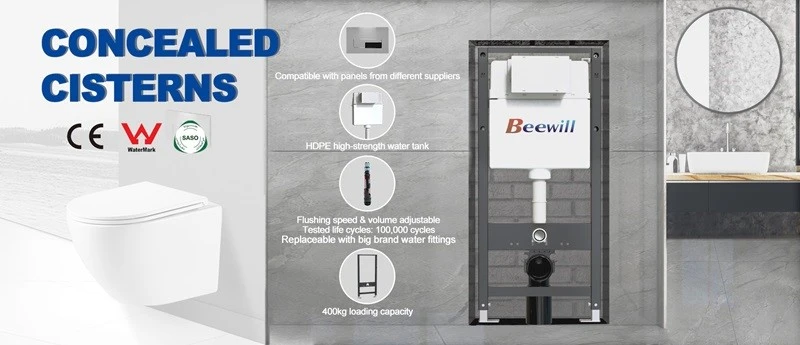
How Do Concealed Cisterns Work?
Feb 04, 2026
How Do Concealed Cisterns Work?
Concealed cisterns are popular in modern bathrooms. They save space, operate quietly, and look clean. But behind the wall, many buyers, distributors, and project contractors often ask the same question: how do concealed cisterns actually work?
This guide explains the internal mechanism, flushing process, key components, installation logic, and long-term performance considerations - all based on real manufacturing and engineering practices.
Quick Answer: How Does a Concealed Cistern Work?
A concealed cistern stores water inside a hidden tank installed behind a wall or within a furniture unit. When the flush plate is pressed, a valve opens to release controlled water flow into the toilet bowl, efficiently removing waste while minimizing water consumption.
- The tank automatically refills after each flush.
- A float valve regulates water levels.
- Dual-flush systems allow users to choose between partial or full flushing.
- All mechanical components remain accessible through the flush plate.
Main Components of a Concealed Cistern
Understanding the internal structure helps buyers evaluate durability, maintenance requirements, and engineering quality.
| Component | Function | Why It Matters |
|---|---|---|
| HDPE Tank | Stores water safely inside the wall | Provides structural strength, leak resistance, and long-term durability |
| Fill Valve | Controls automatic refilling | Ensures consistent water pressure and prevents overflow |
| Flush Valve | Releases water during flushing | Directly impacts flushing performance |
| Dual Flush Mechanism | Offers two flushing volumes | Improves water efficiency |
| Flush Plate | User interface | Allows easy access for maintenance |
Step-by-Step: What Happens When You Flush?
1. The Flush Plate Is Activated
Pressing the flush plate mechanically or pneumatically lifts the flush valve.
2. Water Is Released Instantly
Gravity drives water into the toilet bowl with controlled force to ensure effective waste removal.
3. The Valve Closes Automatically
Once the preset volume is discharged, the valve seals again to prevent water loss.
4. The Tank Refills Quietly
The fill valve restores water to the optimal level while minimizing noise - a critical feature for residential and hospitality environments.
Why HDPE Is the Preferred Tank Material
Most high-quality concealed cisterns use high-density polyethylene (HDPE) produced through injection or blow molding processes. This engineered polymer delivers long-term reliability in enclosed environments.
- Corrosion-resistant: Unlike metal tanks, HDPE will not rust or degrade.
- Impact-resistant: Maintains structural integrity even under building movement.
- Leak-proof construction: Seamless molding reduces failure points.
- Temperature tolerant: Performs consistently across varying climates.
- Lightweight yet strong: Simplifies installation without sacrificing durability.
From our manufacturing experience supplying concealed cistern systems to residential and commercial projects worldwide, the most common performance issues rarely stem from tank failure - but from valve quality and internal engineering precision.
Concealed vs. Exposed Cistern: Key Differences
| Feature | Concealed Cistern | Exposed Cistern |
|---|---|---|
| Appearance | Hidden behind the wall | Fully visible |
| Noise Level | Quieter operation | More noticeable |
| Space Efficiency | Ideal for compact bathrooms | Requires more visual space |
| Maintenance Access | Through flush plate | Direct access |
| Design Appeal | Modern and minimal | Traditional |
As concealed cistern technology continues to evolve, buyers are increasingly prioritizing engineering reliability over basic functionality. Choosing a system backed by real manufacturing expertise significantly reduces long-term installation and maintenance risks.
Modern dual-flush systems are widely adopted across Europe and other water-regulated markets, where efficiency standards increasingly influence bathroom engineering.
Our Manufacturing Standards
Our concealed cistern systems are produced under strict quality management processes and comply with internationally recognized testing standards. This ensures consistent performance, structural reliability, and long-term durability across residential and commercial applications.
Frequently Asked Questions
Are concealed cisterns difficult to maintain?
No. Internal components are accessible through the flush plate, allowing trained technicians to service valves without removing the wall.
Do concealed cisterns save water?
Yes. Dual-flush mechanisms typically reduce water consumption by up to 50% compared to traditional single-flush systems.
Are concealed tanks reliable for long-term use?
When manufactured with high-grade materials and precision valves, concealed cisterns are designed to operate reliably for many years.
Can they support commercial applications?
Absolutely. High-performance systems are engineered to withstand frequent usage in hotels, office buildings, and public facilities.
At their core, they combine smart hydraulic engineering with durable materials to deliver efficient, quiet, and visually streamlined flushing performance.
For distributors, project buyers, and OEM partners, understanding the internal mechanism helps ensure better product selection - ultimately reducing maintenance risks while improving user satisfaction.