What Should Importers Check Before Approving a Concealed Cistern Sample?
Aug 26, 2026
What Should Importers Check Before Approving a Concealed Cistern Sample?
A Practical Sample Approval Guide for OEM Buyers
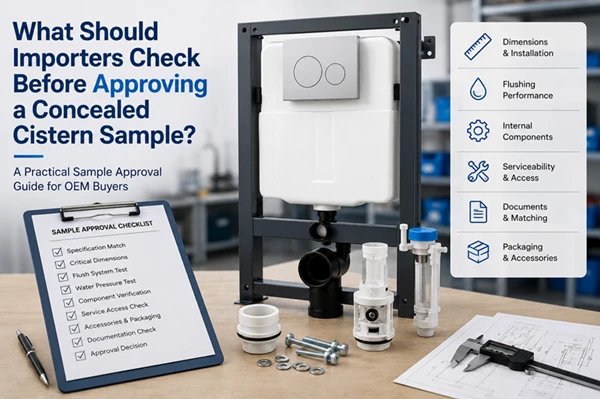
A concealed cistern sample should not be approved simply because it looks good and flushes correctly. Before releasing a bulk order, importers should verify the critical dimensions, installation interfaces, flushing performance, internal components, service access, documentation and final production configuration.
The purpose of sample approval is not just to decide whether one unit is acceptable.
It is to confirm:
"This is the exact configuration I am prepared to receive in bulk."
That distinction is particularly important for OEM and private-label projects. A small change overlooked during sample approval can become a repeated production or installation problem later.
1. Start With the Approved Specification
Before testing the physical sample, compare it with the latest approved specification.
Check the items that directly affect the final product:
Overall and installation dimensions
Tank material
Inlet and outlet configuration
Flush volume
Actuation method
Flush plate or button
Critical internal components
Included accessories
Do not rely only on photographs or the supplier's quotation.
The sample should correspond to the latest approved product version.
If the supplier has made modifications during development, confirm whether those changes have been formally accepted.
For OEM projects, this is where the technical specification becomes important. The specification should establish exactly what the supplier is expected to reproduce in production.
Internal link 1: what should be included in a concealed cistern OEM specification sheet → link to Article 12.
2. Check Critical Dimensions and Installation Interfaces
Not every dimension on a technical drawing has the same importance.
During sample approval, prioritize dimensions that affect installation and compatibility.
Check:
Overall dimensions
Installation depth
Fixing positions
Inlet position
Outlet position
Flush-pipe connection
Actuator opening
Service opening
Adjustable ranges
A small difference in an external dimension may have little practical effect.
A small difference at a pipe connection or fixing point can create a serious installation problem.
A useful rule
Check functional and interface dimensions before cosmetic dimensions.
If the product is intended to work with a specific ceramic or installation system, verify the relevant interfaces before approving the sample.
3. Test the Complete Flush System
A concealed cistern should be evaluated as a complete system rather than as a plastic tank.
The sample should be tested with its actual:
Flush valve
Inlet valve
Actuator
Flush plate
Internal connections
Check whether the system operates smoothly and consistently.
Pay attention to:
Button response
Flush activation
Filling behaviour
Valve shut-off
Recovery after flushing
Abnormal sounds
Dripping after operation
Do not rely on a single successful flush.
Repeated operation can reveal problems that are not obvious during the first test.
If the product has specified full- and reduced-flush volumes, verify the actual configuration rather than relying only on catalogue information.
Internal link 2: flush system configuration for concealed cisterns → link to Article 10.
4. Test Under Realistic Operating Conditions
A factory sample may perform perfectly under ideal conditions.
That does not necessarily mean it will perform the same way in the target market.
Where relevant, consider the expected:
Water pressure
Filling conditions
Installation configuration
Operating frequency
If low water pressure is a concern in the target application, the sample should be evaluated under an appropriate test condition.
The objective is not to simulate every possible installation.
It is to identify whether the product has obvious limitations under the conditions for which it is being purchased.
This is especially important for commercial or multi-unit projects, where a small performance limitation can affect many installations.
5. Check Service Access Before Approving the Design
This is one of the most overlooked areas of sample evaluation.
A concealed cistern may work perfectly during testing but become difficult to maintain after installation.
Open the service access and check whether the main serviceable components can actually be reached.
Pay particular attention to:
Flush valve access
Inlet valve access
Actuator mechanism
Adjustment points
Component removal clearance
Ask:
Can the main serviceable components be removed or adjusted without unnecessary dismantling of the finished installation?
If a valve can technically be replaced but requires excessive access work, the design may create avoidable after-sales costs.
For hotels, residential developments and other projects with many installations, serviceability can be just as important as initial performance.
6. Verify the Critical Components Inside the Sample
The outside of the product does not tell you everything.
For an OEM project, verify that the sample actually contains the components agreed with the supplier.
Where applicable, check:
Flush valve
Inlet valve
Seals
Actuator components
Connections
Other critical parts
Compare them with the approved component list or technical specification.
This matters because similar-looking components can have different operating characteristics.
For example, a replacement valve may fit physically but behave differently in terms of filling, shut-off or flushing.
The key question
Is the component in the sample the same component that will be used in mass production?
If a critical component is still undecided, the sample should not be treated as a completely frozen production reference.
7. Compare the Physical Sample With the Documents
The sample, drawing and component information should describe the same product.
Look for inconsistencies such as:
| Item | Sample | Specification | Action |
|---|---|---|---|
| Flush valve | Model A | Model A | Accept |
| Inlet valve | Model B | Model A | Clarify |
| Connection | 1/2" | 1/2" | Accept |
| Flush volume | 3/6 L | 3/6 L | Verify |
| Flush plate | Version B | Version A | Clarify |
The purpose of this comparison is simple:
The physical product and the production documents must be synchronized.
If the sample contains an unapproved component or modification, resolve it before mass production.
8. Check Packaging and Accessories
Sample approval should also cover what the buyer will actually receive.
Check whether the sample includes the agreed:
Flush plate
Fixings
Connections
Installation accessories
Instructions
Protective components
Then inspect the packaging.
For export orders, consider whether:
Fragile parts are adequately protected
Small components can become loose
The tank is protected from impact
The packaging is suitable for the intended transport method
The packaging matches the approved version
A product that leaves the factory in good condition still needs to arrive at the buyer in good condition.
Therefore, packaging should be approved before the first large shipment rather than treated as an afterthought.
9. Know Which Problems Should Stop Sample Approval
Not every sample issue requires rejection.
The important distinction is whether the problem affects the product's essential performance or production consistency.
Critical issues
These should normally be resolved before approval:
Leakage
Incorrect installation interfaces
Major functional problems
Unapproved critical components
Failure to meet required performance
Significant documentation discrepancies
Major issues
These normally require correction or formal acceptance:
Serviceability problems
Unstable operation
Significant appearance defects
Incorrect accessories
Packaging weaknesses
Minor issues
Small cosmetic imperfections may sometimes be accepted if they do not affect function or the agreed appearance standard.
The important thing is to document the decision.
Instead of writing:
"Please improve the sample."
record:
Problem → Required change → Responsible party → Approval status
This creates a much clearer basis for mass production.
10. Don't Approve a Sample While Important Changes Are Still Open
This is particularly important for OEM projects.
Suppose the sample has been tested successfully, but the buyer still wants to change:
The flush plate
A valve
A bracket
Packaging
An installation component
It is better not to simply mark the sample "Approved."
Use a clear status such as:
Approved subject to agreed modifications
The final production configuration should then be confirmed after the changes have been completed.
Otherwise, there is a risk that the factory treats the original sample as the production reference while the buyer assumes the requested changes are already included.
11. Turn Sample Approval Into a Production Reference
Once all important issues have been resolved, the approved sample should become the reference for mass production.
The production reference should identify:
Product version
Technical specification
Critical components
Important dimensions
Approved modifications
Packaging configuration
Where practical, retain photographs and inspection records as part of the approval file.
This creates a clear connection between:
Approved Sample → Mass Production → QC Inspection → Repeat Orders
It also gives both sides a common reference if a future production batch needs to be compared with the original approval.
Concealed Cistern Sample Approval Checklist
Before releasing the bulk order, importers can use this simplified checklist:
| Area | Check Before Approval |
| Specification | Sample matches the latest approved version |
| Dimensions | Critical installation dimensions confirmed |
| Connections | Inlet, outlet and fixing interfaces checked |
| Flush system | Actual operation and flush configuration verified |
| Repeated operation | System remains stable after repeated use |
| Components | Critical valves and parts match the agreed configuration |
| Serviceability | Main serviceable components are accessible |
| Documents | Sample matches drawings and component information |
| Accessories | Included parts are confirmed |
| Packaging | Export packaging is acceptable |
| Modifications | All requested changes are documented |
| Production reference | Final configuration is clearly frozen |
The checklist does not need to be complicated.
Its purpose is to make sure that the buyer does not approve a sample based on appearance alone.
What Should the Buyer Ask Before Signing Off?
Before giving final approval, ask five simple questions:
1. Is this the correct product version?
If not, clarify the revision.
2. Does it meet the required functional performance?
If not, correct the problem before production.
3. Are the critical components confirmed?
If not, the production configuration is not yet frozen.
4. Can the product be installed and serviced as intended?
If not, the design may create future problems.
5. Is this exactly what I expect to receive in bulk?
If the answer is uncertain, the sample is not ready for final approval.
Final Takeaway
A concealed cistern sample should not be approved simply because it looks right and works once.
For importers and OEM buyers, the important checks are:
Critical dimensions
Installation interfaces
Flush performance
Operating conditions
Service access
Internal components
Documentation
Packaging
Production configuration
The most important question is:
"Would I be comfortable receiving this exact configuration across the entire bulk order?"
If the answer is yes, and all required changes have been documented and confirmed, the sample can become a reliable reference for mass production.
If important questions remain unresolved, it is better to delay approval than to discover the problem after hundreds of units have already been manufactured.
A sample is not just a product to inspect. It is the buyer's last opportunity to define exactly what mass production should deliver.